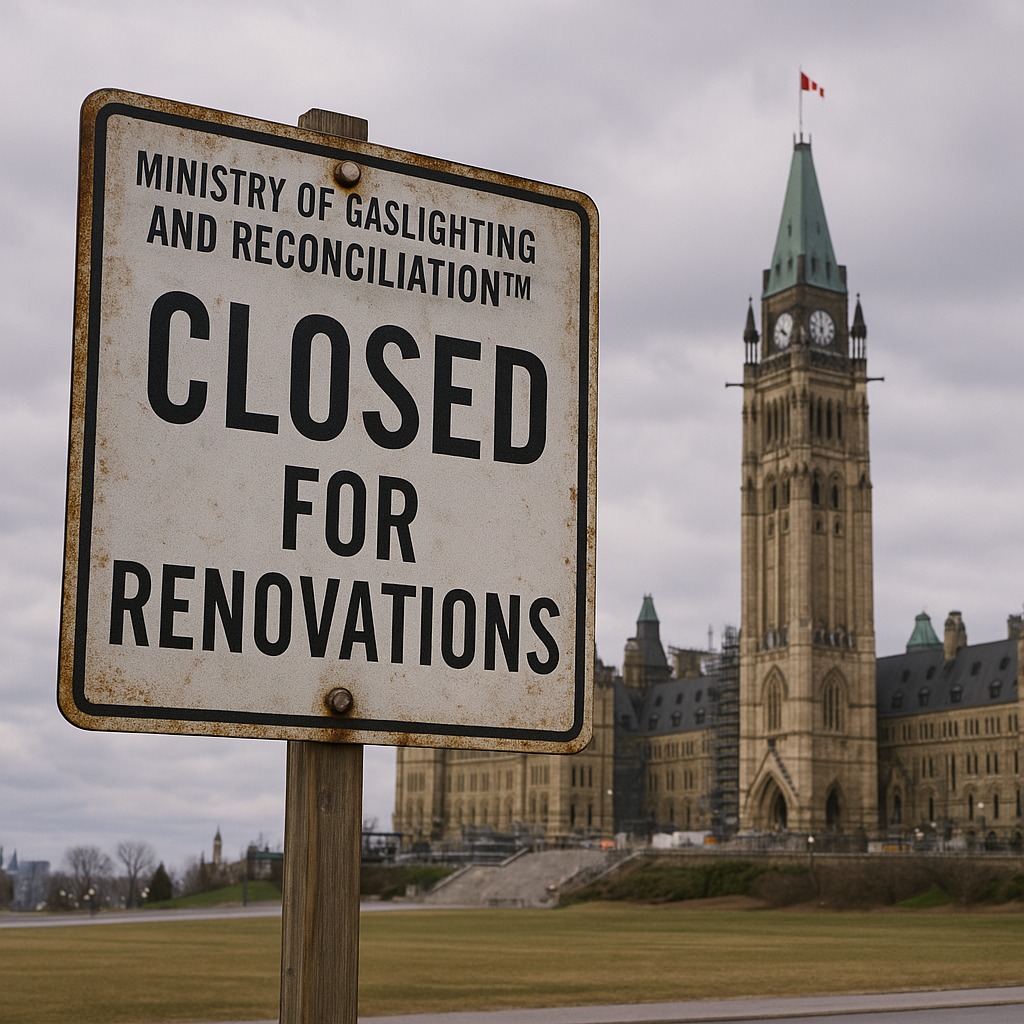
“Ministry of Gaslighting & Reconciliation™ Says: Everything’s Fine, Stop Asking Questions”
Canada has 338 seats in the House of Commons.
To form a majority government, a party needs 170 seats.
Here’s how the numbers break down by region:
104 seats total.
Even if every single Western riding voted the same way?
That still only gives you 104 out of 170 needed for a majority.
That means you cannot form a government with Western votes alone.
You must appease Ontario and Quebec—or you lose.
In Quebec, the Bloc Québécois typically takes 30–40+ seats—automatically skewing the national balance.
They don’t form government, but they siphon enough power to:
Western votes don’t matter if Central Canada doesn’t agree.
And Central Canada doesn’t need the West to win.
This is not a democracy that values regional voice.
It’s a numbers game with the weight rigged east of Manitoba.
We build.
We fund.
We produce.
We sacrifice.
And still—we don’t get to decide the outcome.
Not even close.
“The West doesn’t want to leave.
It just wants to matter.”
And right now?
It doesn’t.
Let’s talk about a truth that doesn’t get enough daylight: money.
The West—Alberta in particular—has been Canada’s economic engine for decades.
Oil. Gas. Agriculture. Innovation. Industry.
But for all we contribute, we’re stuck in the back seat—watching the East steer the vehicle we pay to fuel.
Equalization payments were created to level the playing field. In principle?
Fair enough. Every Canadian should have access to a base standard of services.
But in practice?
It’s a pipeline of Western wealth flowing East—with almost no say in where it goes or how it’s used.
And here’s the kicker:
The very provinces who cash the cheques are often the first to block pipelines, lecture the West on emissions, and rally against the industries footing the bill.
Peter Lougheed, Alberta’s Premier in the 1970s and 80s, wasn’t just a politician—he was a prophet.
He fought like hell to keep control of Alberta’s resources. He knew what was coming:
He wasn’t wrong.
Decade after decade, the West has poured money into a system that doesn’t even pretend to represent us fairly.
We get:
They get:
We produce. We build. We give.
And we get told to be quiet.
“Unity” was never about balance. It was about managing the West while squeezing every drop of economic value from it.
Lougheed warned us.
Ottawa ignored it.
And we’re still footing the bill.
Read the book On the Take by Stevie Cameron.
Then come back and try to tell me Brian Mulroney deserves a statue. It’s required reading if you really want to understand the rot behind the rhetoric.
You want to know how deep the fracture between East and West goes?
Start with Meech Lake.
In 1987, Prime Minister Brian Mulroney tried to pull off a constitutional miracle. He wanted Quebec to finally sign onto the 1982 Constitution—something it had refused to do. The price?
It looked like unity.
It was branded as healing.
But for Western Canada, it felt like a handshake made behind locked doors.
The West didn’t get more say.
The West didn’t get stronger representation.
What we got was a deeper sense that we were there to be managed, not heard.
The Accord died in 1990—not because the West rejected it, but because Newfoundland and Manitoba did. But by then, the damage had metastasized.
“Unity,” we learned, was just a rebranded word for compliance.
Where was Mulroney when the smoke cleared?
Still clinging to the illusion that power could be balanced…
if you just gave Quebec more than everyone else.
You’re not wrong.
Meech Lake was a warning shot.
It missed the East, but hit the West straight in the chest.
Let’s talk about truth in context. If the opening section left your stomach unsettled, good. Now chew on this:
The Bloc Québécois is one of the clearest, most uncomfortable truths in Canadian politics. A party that doesn’t run candidates in the West. Doesn’t campaign for your vote. Doesn’t represent your interests. And yet…
They sit in Ottawa. They vote on national policy. They influence the future of provinces they have no accountability to.
The Bloc Québécois (BQ) was formed in 1991 by former Progressive Conservative and Liberal MPs, frustrated after the failure of the Meech Lake Accord—a failed bid to bring Quebec into the 1982 Constitution by recognizing it as a “distinct society.”
Source: Canadian Encyclopedia – Bloc Québécois
The Bloc only runs in Quebec. Its sole mandate? To represent Quebec—and in some cases, push for sovereignty.
Despite being a regional party, it won 54 out of 75 seats in Quebec in 1993, becoming the Official Opposition in Parliament. A party accountable only to one province became the main voice challenging the federal government.
Today, they still hold over 30 seats, tipping votes, shaping debates, and steering national direction—while millions of Canadians in the West have zero say in their presence or power.
It means we’re spectators in a game where only certain teams are allowed to score. It means our votes are diluted, our voices sidelined, and our needs parked behind closed doors.
This isn’t representation. This is regional imbalance dressed up in federal robes.
For all the folks jumping on the Carney wagon, blinded by a polished resume and global endorsements—wake up.
Carney is just Trudeau with a commerce degree. Same agenda, same priorities, just wrapped in a more business-speak package.
And then there’s Pierre Poilievre—who, let’s be honest, talks a big game but shows up as little more than a “PP” in the grand scheme of things. Loud in opposition, soft on substance. Another empty suit in a long line of them.
Meanwhile, the West is left holding the bag again.
We’re the engine that keeps this country moving—through agriculture, energy, industry—but we’re treated like an inconvenient outpost to be managed, not represented.
We have no real voice.
Not in the House.
Not in the press.
Not in the decisions that get made about how our work is taxed, how our resources are regulated, or how our values are dismissed.
Instead, the Canadian population is once again too busy obsessing over the “big bad monster” south of the border, pointing fingers at American politics, while we ignore the rot in our own backyard.
While they mock U.S. division, we’re watching our own nation quietly fracture along lines of geography, values, and representation.
But it’s easier to fear the elephant in the room next door than face the fact that we’re being governed by a system that no longer even pretends to respect the West.
So no—I’m not buying into the Carney illusion.
No—I don’t think Poilievre has what it takes.
And no—I don’t believe this country is headed anywhere good unless we start calling it for what it is.
We need leadership that respects the people who still build, haul, dig, grow, and fight.
Not more handlers, more PR, more fake federalism, and certainly not another smooth-talker in a better suit.
This is my take.
If it ruffles feathers—good.
If it makes someone uncomfortable—maybe it should.
Because out here in the West, we’ve been uncomfortable for a long damn time.
Lately, some Canadian towns have been voting to remove the U.S. flag from hockey arenas, supposedly to make some kind of “statement.” But let’s take a step back and ask:
What kind of message are we sending to our kids?
We tell them to be fair, respectful, and good sports, yet we’re the ones acting small, bitter, and petty. We’re literally teaching them:
🔹 “Respect is conditional” – We’ll respect a flag only if it suits our mood today. Otherwise, it’s disposable.
🔹 “Sportsmanship is secondary to politics” – Hockey is supposed to bring people together, but now we’re using it as a battlefield for performative outrage.
🔹 “Contradictions are fine if they fit your narrative” – We’ll take down U.S. flags in protest, but we’ll still watch the NFL every Sunday, shop at U.S. stores, and stream U.S. media without a second thought.
How do we explain to them that we took down the U.S. flag out of spite, while American arenas still fly the Canadian flag out of respect?
How do we tell them that sports should be about unity, while we’re busy tearing down symbols of respect?
How do we justify being outraged at U.S. policies, but still consuming U.S. entertainment, sports, and products daily?
This isn’t about patriotism or making a real change—this is about cheap, performative gestures that do nothing but breed division, hypocrisy, and childish tribalism.
If we really want our kids to grow up in a world where respect matters, sportsmanship is valued, and critical thinking still exists, then maybe we should start acting like the adults we expect them to become.
Otherwise, we’re just raising the next generation to believe that respect is just another tool for outrage. And that’s not something I’m okay with.
What do you think? Does this kind of behavior make Canada stronger, or just smaller?
A space for thought, for questions, for seeing through the noise. Not for the faint of mind. Stay tuned—if you dare.
💀 You think you’re in control.
💀 You think you make your own decisions.
💀 You think you consume information freely.
But do you?
🚨 Every time you open your phone, you aren’t choosing what to see.
🚨 The algorithm decides for you—what you read, what you watch, what you believe.
🚨 Your attention is being directed, manipulated, and sold.
🔹 Your search results aren’t neutral. They’re ranked based on what makes you stay longer.
🔹 Your news feed isn’t unbiased. It’s filtered to fit your engagement patterns.
🔹 Your recommendations aren’t random. They’re designed to reinforce what you already think.
✔ Google doesn’t give you answers—it gives you the most clickable answers.
✔ Social media doesn’t inform—it reinforces what you already believe.
✔ Every platform wants one thing: your attention. Because attention = money.
🚨 The more predictable your behavior, the easier you are to control.
💡 Can you think for yourself when everything is designed to make you stop thinking?
💡 Can you question the narrative when the algorithm keeps feeding you what you want to hear?
💡 Can you see past the illusion, or are you just another programmed reaction?
The internet was supposed to make us smarter. Instead, it just made us easier to manage.
So, are you still thinking, or is the algorithm thinking for you?
There we are then.
🚨 We are witnessing the death of critical thinking in real time.
Not because people can’t think—but because they no longer know how.
💀 Headlines replaced reading.
💀 Memes replaced research.
💀 Feelings replaced logic.
We don’t seek truth anymore—we seek confirmation.
We don’t challenge ideas—we attack the person who holds them.
The result? A society that reacts, rather than thinks.
 There We Are Then